Industrial Overcapacity Can Enable Seasonal Flexibility in Electricity Use
Published in Nature Energy, 2026
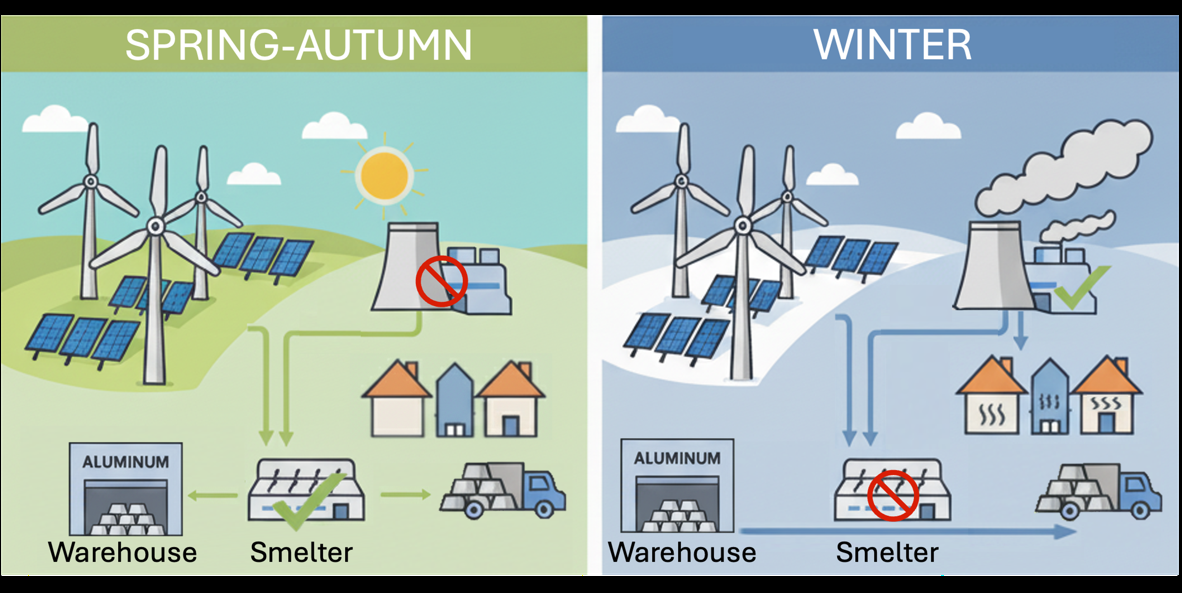
Seasonal operation paradigm for aluminum smelting: producing and storing more in renewable-abundant seasons, then reducing production during winter peak-load periods.
A New Paradigm for Grid-Load Interaction
As wind and solar power become central to future electricity systems, power system flexibility is needed not only within hours or days, but also across seasons. This work explores a new paradigm for energy-intensive industrial users: using moderate industrial overcapacity and product storage to provide long-duration, seasonal flexibility to the power system.
The key idea is that some energy-intensive industries can produce more when renewable electricity is abundant and inexpensive, store products, and then reduce or stop production during seasons when electricity supply is tight and prices are high. In this way, industrial production can become better aligned with the seasonal patterns of renewable energy.
From Overcapacity to Flexibility
Industrial overcapacity is often viewed as an economic inefficiency. However, in a decarbonized electricity system with high renewable penetration, moderate overcapacity may become a valuable flexibility resource.
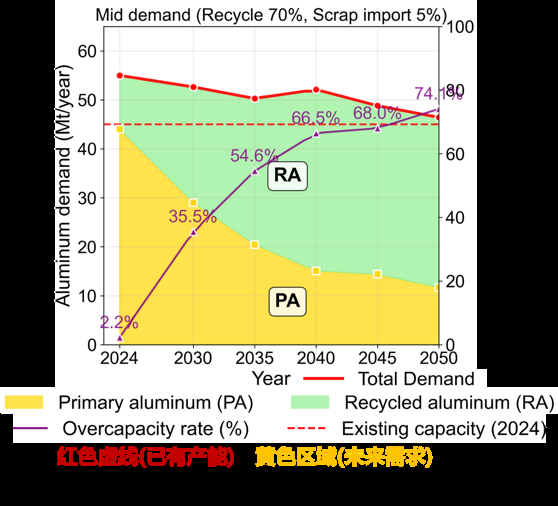
Projected aluminum demand and potential overcapacity in China, illustrating how unused production capacity can become a flexibility resource.
Using China’s aluminum smelting industry as a representative case, we show that aluminum producers could operate at high output during seasons with abundant low-cost renewable electricity, while strategically reducing or ceasing production during winter peak-load periods. Product inventories then help satisfy demand while production is temporarily reduced.
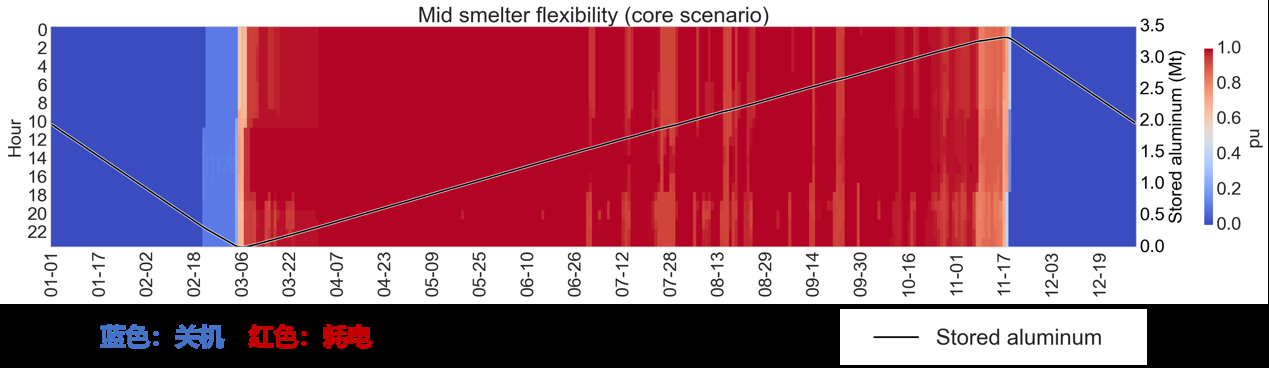
Optimal seasonal operation of aluminum smelters in a 2050 scenario, where production is concentrated in lower-cost periods and stored products bridge winter curtailment.
This seasonal operation pattern differs from conventional short-term demand response. It avoids frequent hourly or intra-day production adjustments that could reduce efficiency, increase equipment fatigue, or introduce process risks for continuous industrial production.
System and Industrial Benefits
The study evaluates this paradigm by coupling detailed models of energy-intensive industrial production with power market and electricity system operation models. The results show that overcapacity-enabled seasonal operation can create benefits on multiple levels:
- Power system benefits: Seasonal aluminum smelting flexibility can reduce annual investment and operating costs in China’s decarbonized electricity system by 23-32 billion CNY, equivalent to 11%-15% of the aluminum smelting industry’s product value.
- Industrial cost benefits: Although seasonal operation introduces costs from idle capacity, electrolytic cell restarts, product storage, and working capital, aluminum producers can still reduce total production costs by more than 1,500 CNY per tonne by consuming more low-cost green electricity.
- Social transition benefits: Seasonal labor needs in aluminum smelting and thermal power generation may be partly complementary, offering a potential way to reduce employment fluctuations during the energy transition.
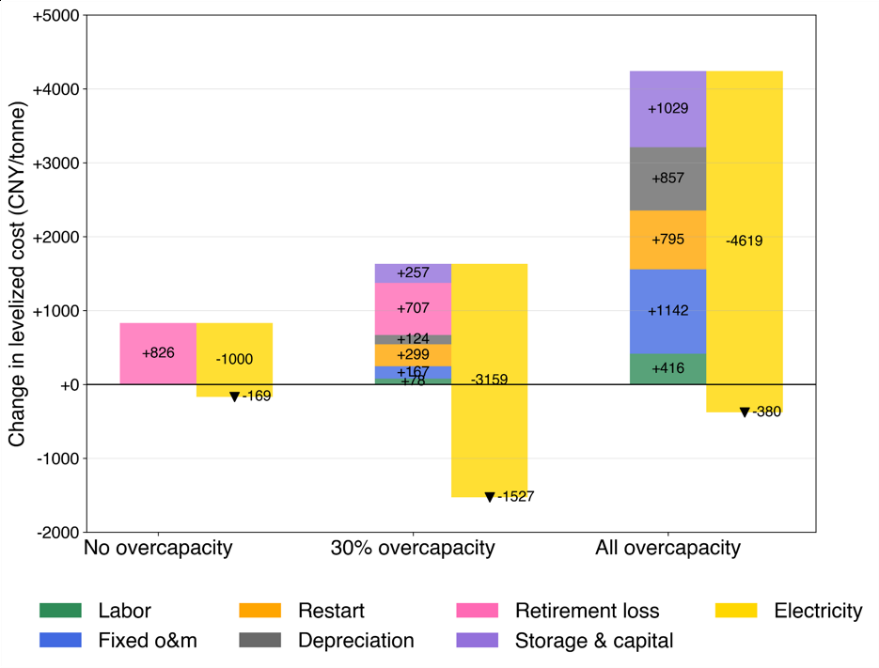
Changes in levelized aluminum production cost under different overcapacity assumptions, showing how lower electricity costs can offset additional operational costs.
Broader Implications
This work suggests that future industrial users do not need to remain passive electricity consumers. With appropriate electricity market mechanisms and production planning, energy-intensive industries can actively support renewable energy integration while improving their own green competitiveness.
The aluminum smelting case provides an entry point, but the broader idea may also inform how steel, cement, and other energy-intensive sectors participate in low-carbon power system transformation.
Resources
- Published Paper: Nature Energy
- Chinese News Release: Tsinghua EILAB news draft
Citation
R. Lyu, A. Li, J. Wang, H. Luo, Y. Shen, H. Guo, E. Du, C. Kang, and J. Jenkins, “Industrial overcapacity can enable seasonal flexibility in electricity use,” Nature Energy, vol. 11, pp. 1203–1215, 2026, doi: 10.1038/s41560-026-02073-y.