Industrial Flexibility Modeling Toolkit
Published:
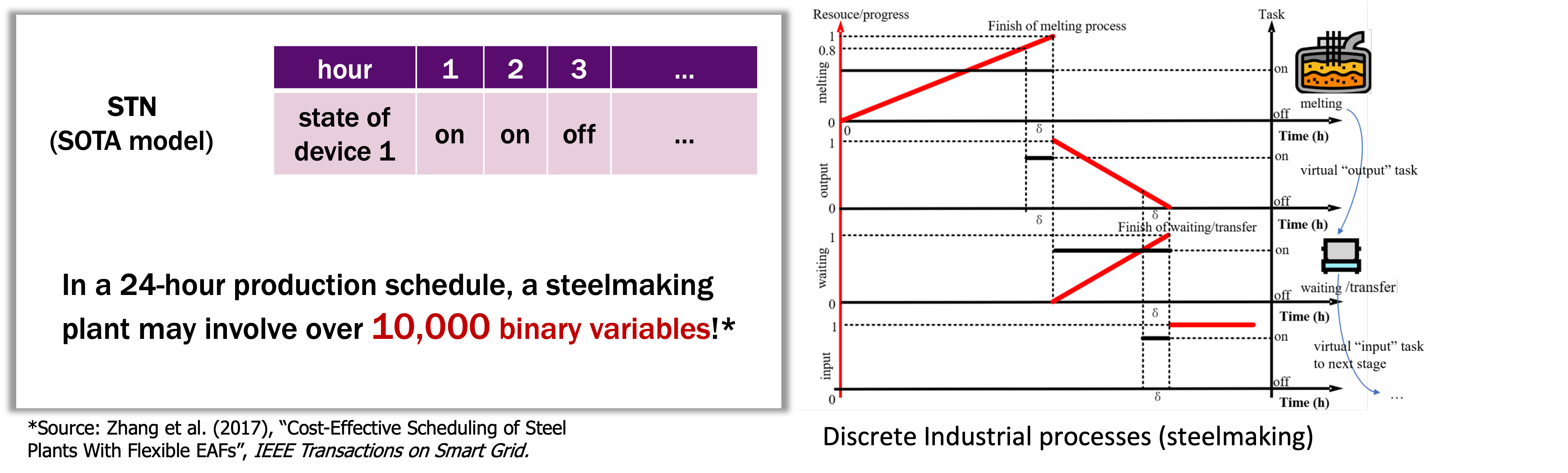
The problem
Industrial demand flexibility is governed by material flows, task sequences, inventories, and discrete operating requirements. Simplified load models are tractable in power-system studies but can misrepresent these constraints, while detailed production-scheduling models are often too computationally intensive for system planning and real-time operation.
What I developed
I developed a connected modeling toolkit that makes physically grounded industrial-load models usable in power-system applications:
- a continuous Resource Task Network that represents material flows and production tasks with far fewer binary variables;
- an inverse optimization method that infers plant scheduling parameters from smart-meter and electricity-price data;
- a data-driven reduction method that converts detailed industrial constraints into compact models for system-scale studies; and
- real-time coordination methods that connect these models with virtual-power-plant operation.
Key result
In a steelmaking case, the reduced model replaced 10,208 integer variables with 48 continuous variables while reproducing the detailed model’s optimal load profiles with a normalized RMSE of 3.9% on test data. This body of work formed the methodological core of my Ph.D. dissertation, and its open-source implementations have received more than 200 GitHub stars.