Seasonal Industrial Flexibility
Published:
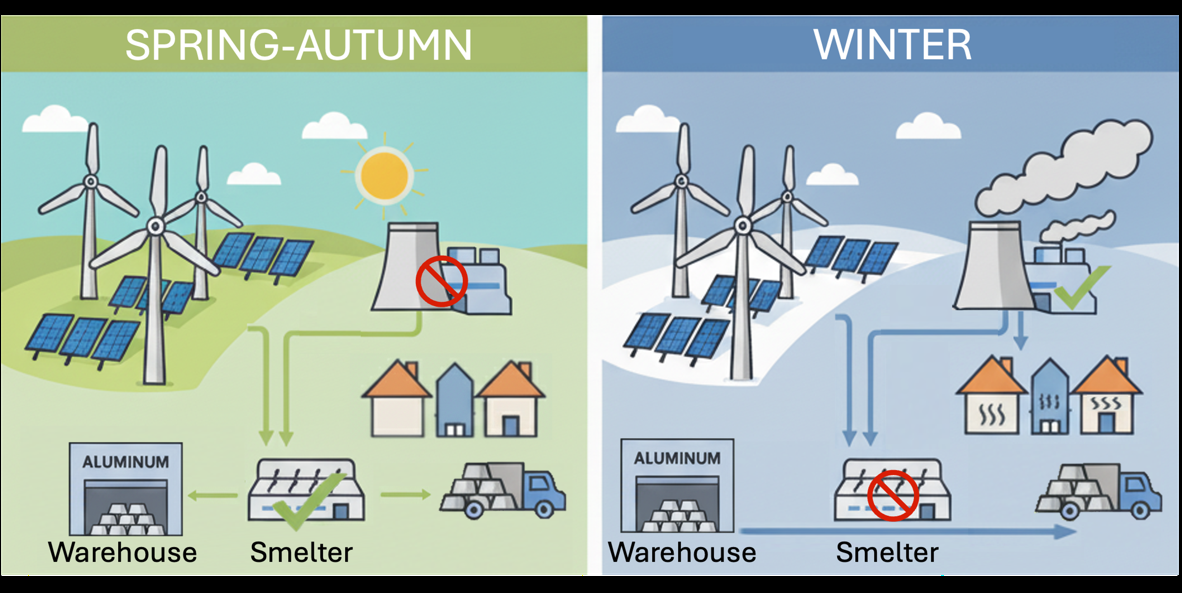
The problem
Power systems with high shares of wind and solar need flexibility not only within hours or days but also across seasons. Conventional demand-response studies usually treat production capacity and inventories as fixed, overlooking how these investment choices determine the duration and timing of industrial flexibility.
What I developed
I developed a national-scale co-optimization framework linking industrial operations with power-system expansion. The framework incorporates the thermal and material constraints of aluminum smelting and uses decomposition to make the joint planning problem tractable.
The central mechanism is that spare production capacity and product inventories allow energy-intensive industries to produce more when renewable electricity is abundant, store products, and reduce production when electricity supply is tight. This turns industrial overcapacity—usually viewed as an economic inefficiency—into a potential source of long-duration grid flexibility.
Key result
Across the investigated scenarios for China’s aluminum sector, seasonal industrial flexibility reduced annual electricity-system costs by CNY 23–32 billion, equivalent to 11–15% of the aluminum smelting industry’s product value. The study was selected as the cover article of the August 2026 issue of Nature Energy and was discussed in a dedicated Joule Preview.